


Your organization’s most valuable data probably sits in on-premise systems. Meanwhile, your business teams need easier access and faster insights. How do you bridge that gap without putting your company at risk? Let’s talk about Collibra Edge – a secure, scalable tool we use all the time to connect our clients’ on-premise data to their cloud-based data governance ecosystems.
What is Collibra Edge?
Let’s start with the formal Collibra’s definition of Edge:
Edge is a cluster of Linux servers for accessing and processing data close to where it resides. It helps to connect to data sources and process information within your data landscape.
At its core, Collibra Edge is a lightweight, secure, and scalable runtime environment that runs within your network (on-premise or private cloud). It serves as a local execution engine enabling Collibra Cloud to connect to, ingest, and process data from sources that can’t be accessed directly over the internet.
And it’s usually one of the first things we set up in our data governance projects for our clients.
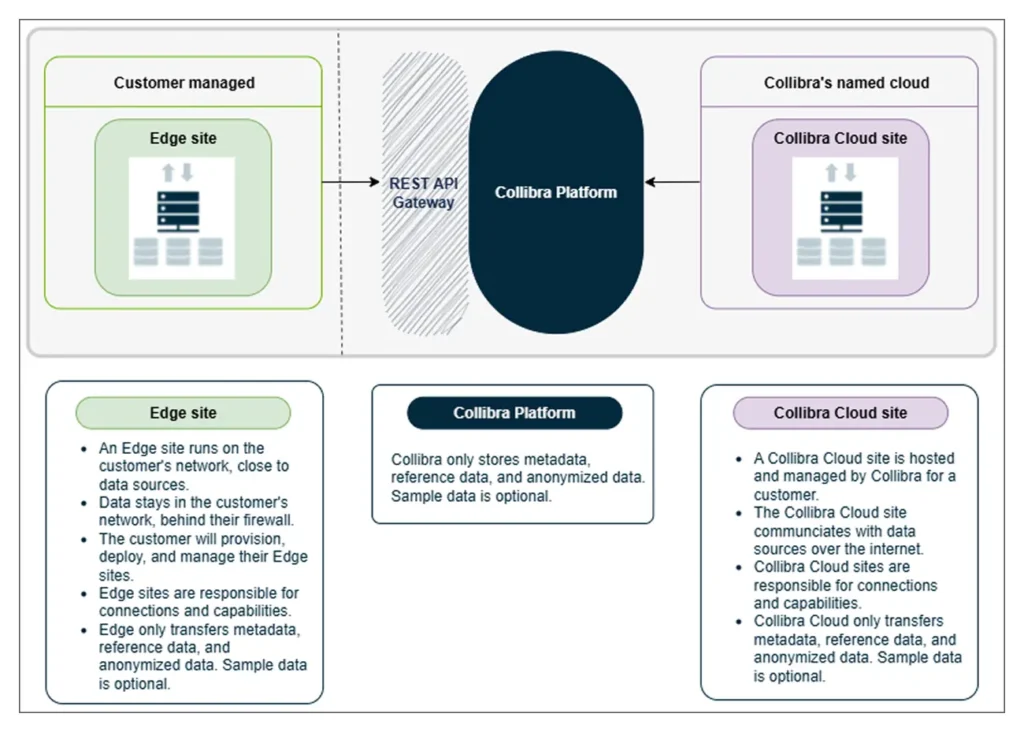
To get (just a little bit, but not too much) technical, Collibra Edge consists of three main components:
- An Edge configuration page in the Collibra Platform to create and install Edge sites.
- An Edge integration capability repository that resides on the Collibra Platform and contains all features that can run on an Edge site.
- An Edge site installed close to a data source in a client’s environment – in the cloud or on-premise.
And – perhaps more importantly for the purposes of this article – key features of Collibra Edge include:
- Local processing:
Edge executes tasks (like metadata ingestion, data profiling, or classification) close to the data source, in compliance with data residency and security policies. - Secure connectivity:
Communication between Edge and Collibra Cloud is encrypted end-to-end using TLS. The connection is always outbound-only, meaning your firewall stays closed to inbound traffic. - Scalability and automation:
You can deploy multiple Edge sites across different data centers or geographies to handle diverse data sources and workloads. Edge jobs can be scheduled and automated, so metadata and profiling stay up-to-date without manual effort. - Central orchestration:
While execution happens locally, management and orchestration occur centrally in Collibra Cloud. That means governance teams get a single pane of glass for visibility and control – even across hybrid architectures. - Integration flexibility:
Edge supports connectors for major on-premise databases and tools like Oracle, Teradata, SQL Server, DB2, and others. You can also extend it for custom data sources.
In short, Edge makes hybrid data governance possible. It connects Collibra’s cloud intelligence with your on-premise reality – securely, efficiently, and at scale.
The three business problems Collibra Edge can help you solve
While everyone’s talking about “digital transformation” and “cloud-first strategies,” the reality is more complicated. The data you need to power those initiatives often can’t simply be moved to the cloud. Between strict data residency regulations (like GDPR) and internal security policies, relocating sensitive data isn’t always legal – or even smart.
Here are the three biggest challenges we see – and how Collibra Edge helps solve them:
1. Compliance risks
Your organization must comply with data residency laws like GDPR, which restrict where personal or sensitive data can be stored and processed. In practice, this means a large part of your data – especially customer or employee information – must remain within specific jurisdictions.
The consequences:
Moving or even temporarily copying that data across borders without proper safeguards can lead to severe penalties. We’re talking fines up to 4% of your global annual turnover, not to mention the reputational damage and legal fallout that follow.
One of the most (if not the most) spectacular examples of this is Meta Platforms Ireland, fined €1.2 billion by the Irish Data Protection Commission in 2023 for unlawful transfers of personal data from the EU to the U.S. without adequate safeguards.
The business impact:
A single compliance violation can result in millions (or even billions) lost in fines, legal fees, and lost customer trust. The irony here is that most companies break compliance rules not out of negligence, but because their teams can’t access or analyze the data where it resides, so they copy it into unapproved systems just to get work done.
The solution:
Collibra Edge provides a simple but powerful solution: it allows you to process and analyze data where it lives – within your on-premise environment – without moving it to the cloud.
And that means that:
- Data stays within its legal and physical boundaries.
- Edge runs local jobs (like metadata ingestion, profiling, or classification) directly on your on-premise systems.
- Only the metadata and results are shared with your Collibra Cloud – not the raw data itself.
You get full visibility and compliance insights without compromising data residency. The data never leaves its secure location, but you still gain the governance and intelligence your teams need.
2. Rising inefficiency
Your analysts and data scientists can’t find or trust the data locked in legacy systems. Maybe you’ve built a beautiful cloud data catalog, but it’s missing half the picture – that is everything stored on-premise.
The consequences:
Teams waste time looking for data or rebuilding datasets they already have. Projects are delayed because the right data isn’t available. Decisions get made based on incomplete or outdated information. And the inefficiency adds up really fast.
The business impact:
Think of it this way: you’re paying top data talent to spend hours each week manually discovering and reconciling data – instead of using it to generate insights. That’s a massive productivity drain.
Meanwhile, your business strategy slows down because of the holes in your analytics foundation. Marketing can’t get accurate customer segmentation. Finance can’t reconcile reports. Operations can’t track performance across regions.
The solution:
Collibra Edge automatically maps and connects your on-premise data sources – like Oracle, SQL Server, or Teradata – with your cloud-based Collibra Data Catalog. You can integrate it with data lakes, e.g., in Snowflake and Databricks, and BI tools like Tableau and Power BI.
It ingests and synchronizes metadata from those systems securely, in real time, so your catalog finally gives you a complete picture of your enterprise data landscape. And with its technical lineage capabilities, you can visualize the entire data flow.
That means:
- Everyone can discover and understand data, no matter where it resides.
- Governance teams can apply consistent policies across environments.
- Analysts can trust the context behind every dataset they use.
And the result is you turn data chaos into a connected ecosystem.
3. Hindered innovation
You’ve set your sights on using AI, machine learning, or predictive analytics to transform the business. But the most valuable data needed for those models, like supply chain metrics or product performance, still lives in on-premise databases.
And because of compliance and security requirements, you can’t just move it to the cloud.
The consequences:
Your cloud initiatives stall. Your data scientists work with incomplete datasets. The insights your business needs to stay competitive simply don’t materialize.
The business impact:
It’s a strategic risk. Organizations that can’t integrate all their data across cloud and on-premise will eventually fall behind. You can’t build the 360-degree customer views, AI-powered personalization, or intelligent supply chains that today’s industry leaders do.
The solution:
Collibra Edge acts as a secure bridge between your cloud governance and on-premise data. It lets your organization:
- Run data intelligence processes (like data quality checks or discovery) locally.
- Share insights, not raw data, with your cloud analytics or AI platforms.
- Maintain control and compliance while still fueling innovation.
You no longer have to choose between security and agility. With Edge, you get both – enabling cloud-scale innovation powered by your full, governed data estate.
Putting Edge to work: key use cases for your team
Once deployed, Collibra Edge unlocks tangible value for different teams across your organization. Here are three common (and high-impact) use cases we see with our clients.
Use case 1: Building a complete enterprise data catalog
The action:
Use Collibra Edge to automatically register and ingest metadata from your on-premise data sources – Oracle, Teradata, SQL Server, and others – into your central Collibra Data Catalog.
The challenge it solves:
Most enterprise data catalogs are incomplete because they only cover cloud data. That leaves significant visibility gaps across legacy systems – the ones often holding your most critical operational data.
The business value:
By integrating on-premise systems through Collibra Edge, you finally get a complete enterprise data map. Edge turns fragmented systems into a unified, searchable ecosystem – a single source of truth for your data landscape.
And that means:
- Analysts can discover datasets across the organization from one interface.
- Data stewards can enforce consistent policies across all assets.
- Business leaders gain confidence that they’re seeing the full picture.
Bonus case study:
Check out how we helped a leading DACH retailer optimize their overall data management, including reducing Edge resource requirements that led directly to lowering operational costs.
Use case 2: Automating sensitive data discovery & classification
The action:
Run profiling and classification jobs on Collibra Edge to automatically detect sensitive data, like personally identifiable information (PII), protected health information (PHI), or financial data, within your on-premise systems.
The challenge it solves:
Identifying sensitive data manually across hundreds of legacy systems is nearly impossible. Without visibility, you can’t enforce proper access controls, prove compliance, or respond efficiently to audits.
The business value:
Edge allows you to discover and tag sensitive data where it resides, without moving it. The results are visible centrally in Collibra, giving governance teams:
- A complete inventory of sensitive data assets.
- Automated tagging and lineage for compliance documentation.
- Evidence to demonstrate regulatory adherence to auditors and stakeholders.
This directly mitigates your compliance challenge from earlier on – giving you real-time visibility and control over sensitive information while ensuring nothing leaves its secure environment.
Bonus case study:
See how we helped a Swiss bank manage and catalog sensitive critical data elements to comply with FINMA Circular 2023/01.
Use case 3: Monitoring data quality at the source
The action:
Define and execute data quality rules locally through Collibra Edge, right where your data lives. The data quality metrics and results are sent securely to Collibra for centralized reporting and governance.
The challenge it solves:
Traditionally, to monitor data quality, organizations had to copy or replicate data into another system, introducing latency, cost, and risk.
With Collibra Edge, you can measure and monitor data quality without moving the data.
The business value:
- You maintain trust in data across departments and systems.
- You reduce the need for downstream cleansing and reconciliation.
- You enable proactive governance with near-real-time quality insights.
This is how organizations build credibility around data-driven decisions. When every team trusts the data they’re using, because quality is measured and visible from the source, innovation moves faster and with fewer surprises.
Bonus case study:
Here’s how we helped an international retail chain enhance data quality at scale, among other things.
Turning the technical edge (pun intended) into business value
At Murdio, when we work with clients on implementing Collibra, our goal is always the same: translate technical capabilities into business impact. And while Edge is a powerful piece of technology, it’s just a piece of the puzzle. What’s really important is what it unlocks – compliant innovation, efficient operations, and company-wide trust in data.
And that will benefit different teams across your organization with:
- Reduced risk exposure and accelerated digital transformation as Edge helps align governance with compliance.
- Saved time for data teams, helping eliminate manual work, and giving full visibility into data assets.
- Faster insights and innovation by connecting the dots between your most valuable data and your most strategic tools.
So, really it’s an enabler for the next phase of your organization’s data maturity.
Want to explore Collibra benefits for your organization’s specific needs?
Reach out and let’s schedule a conversation with a Murdio data governance expert to find the optimal solutions for your business.
FAQs about Collibra Edge
1. Is Collibra Edge required for every Collibra deployment?
Not necessarily. Collibra Edge is essential when your organization needs to connect Collibra Cloud to data sources that aren’t directly accessible via the internet (for example, databases behind firewalls or in private networks). If all your data sources are already cloud-native and accessible through standard APIs, you might not need Edge.
2. How does Collibra Edge differ from traditional data integration tools?
Edge isn’t an ETL or replication tool. It doesn’t move or transform your data. Instead, it allows Collibra Cloud to interact with on-premise systems securely – executing metadata ingestion, profiling, or quality checks in place and sending only results or metadata to the cloud. This makes it ideal for compliance-sensitive environments.
3. Can Collibra Edge process large volumes of data efficiently?
Yes. Edge is designed for scalability. You can deploy multiple Edge sites to distribute workloads across data centers or regions, ensuring high performance even with enterprise-scale datasets. It’s built to handle parallel processing, scheduled jobs, and ongoing automation.
4. What security measures protect data when using Collibra Edge?
Edge communicates with Collibra Cloud through an encrypted, outbound-only TLS connection. No inbound connections are required, so your firewall remains closed. Only metadata and job results are transmitted – raw data never leaves your environment.
5. How does Collibra Edge support data residency and regulatory compliance?
By processing data locally – within your own infrastructure – Edge helps maintain compliance with data residency laws like GDPR, HIPAA, and similar frameworks. Since sensitive data isn’t copied or transferred to the cloud, organizations can confidently operate within regional and industry-specific legal boundaries.
6. Can Edge support hybrid or multi-cloud architectures?
Absolutely. Edge was built for hybrid and multi-cloud data landscapes. Whether your systems run on-premise, in AWS, Azure, GCP, or private clouds, Edge enables secure connectivity and unified governance across all environments.
7. How is Collibra Edge deployed and maintained?
Edge runs as a cluster of Linux servers managed centrally from Collibra Cloud. Deployment is typically handled by your IT or DevOps team using Collibra’s installation scripts and documentation. Updates and patches are managed automatically through Collibra’s release cycles, minimizing operational overhead.
About the Author

Share this article
Related Articles
See all-

7 January 2026
| Collibra experts for hireData governance framework. Best practices & examples
-

6 January 2026
| Collibra experts for hireBuilding a data governance strategy
-

6 January 2026
| Collibra experts for hireData observability vs data quality: key differences