The definitive guide to the Collibra and SAP alliance
SAP delivers data at scale. Collibra makes it usable, trustworthy, and safe. Learn how their alliance enables governed analytics and AI across complex enterprise data landscapes.
SAP alone is not a universal governance platform. It excels at running core business processes, but it lacks an enterprise-wide governance layer that spans both SAP and non-SAP data, analytics, and AI use cases.
Collibra provides the missing control plane, adding business context, ownership, lineage, data quality, and policy enforcement on top of SAP data platforms.
The SAP-Collibra alliance enables a true business data fabric. Together, the platforms unify metadata, governance, and quality across SAP Datasphere, SAP Analytics Cloud, SAP HANA Cloud, and SAP Business Data Cloud.
Without the unified governance layer, data quality issues, semantic misinterpretations, and compliance gaps might rapidly scale when SAP data feeds BI, AI, and external systems.
The partnership removes common transformation blockers. It addresses AI risk concerns, S/4HANA migration uncertainty, and dependency on legacy governance tools that no longer scale. All in a future-proof way, letting you avoid worrying about constant tool-switching.
Native SAP tools and Collibra are complementary, not interchangeable. SAP MDG and Information Steward serve specific purposes, while Collibra operates as the enterprise governance layer across the entire data ecosystem.
Implementation success depends on execution. Organizations that pair SAP and Collibra with a clear operating model and experienced partner (like Murdio) see value faster and avoid governance becoming shelfware.
The core challenge for every SAP enterprise
If you’ve worked in an SAP enterprise, you know this dynamic well. SAP systems generate massive volumes of business-critical data, from ERP and CRM to supply chain, HR, finance, and operational reporting.
SAP’s HANA-based applications are really comprehensive and powerful, but their native tooling focuses primarily on operational processes and storage. They don’t inherently give a complete, business-friendly view of data governance across all data sources, especially when you bring in non-SAP systems, cloud platforms, analytics tools, or AI models.
This often creates a core challenge:
SAP provides robust platforms to run your business
But doesn’t give you a single, enterprise-wide governance layer that unifies metadata, data quality, lineage, policies, ownership, and AI governance across multi-source landscapes.
Without that layer, enterprise teams struggle to answer basic questions around:
lineage
ownership
quality
AI governance, and more.
For SAP-powered enterprises, where upwards of 80% of mission-critical operational data originates from SAP applications, a system of engagement for data intelligence is the prerequisite for digital transformation.
And Collibra is a great candidate. It provides the governance foundation that operational SAP landscapes lack, especially as enterprises modernize their data and AI strategies. And when you connect the two – that’s when data governance happens. (Because it’s definitely not magic. Actually, it’s Collibra Edge, acting as a bridge and providing a secure, scalable runtime environment that resides within the organization’s own network, whether on-premise or in a private cloud.)
A business data fabric to unify your data landscape
One of the core concepts SAP and Collibra unanimously emphasize is a business data fabric. This might seem like a buzzword at first – but it’s really more than that. An architectural approach that stitches together data from varied sources (SAP and beyond) into a governed, searchable, and trusted mesh.
A business data fabric does three things well:
Connects diverse systems like SAP, cloud, analytics, third-party sources instead of just storing data in a silo.
Enriches metadata and context so data consumers understand meaning, lineage, quality, and usage.
Supports governance and assurance workflows, so policies and quality checks are enforced consistently.
Collibra integrates deeply with SAP data platforms like SAP Datasphere and SAP Analytics Cloud, bringing SAP metadata and assets into Collibra’s governance view. This means data assets – tables, columns, models, and relationships – sync into Collibra’s data catalog and intelligence platform, making them discoverable and governable alongside non-SAP assets.
This unified fabric is particularly important as you scale your AI initiatives, migrate to SAP S/4HANA, or modernize your analytics environments. When there’s no unified governance layer, data remains fragmented across tools and teams. And this means decision-making slows down and data risks go up.
And the risk is not that SAP data is wrong. It’s just that once SAP data is reused for analytics and AI without governance, errors, misinterpretations, and compliance issues scale faster than humans can detect them. And that leads to all sorts of consequences, including failed audits, misleading AI outputs, and inadequate business decisions – even if the data technically looks “fine” on the outside.
Risks the Collibra and SAP partnership solves
1. AI governance risks
AI adoption is exploding, but it’s also exposing a major data governance gap: enterprises can’t blindly trust the data fueling AI models. Without comprehensive AI governance, automated lineage, quality checks, and business context, AI projects might produce biased, inaccurate, or non-compliant outputs.
This means that if you don’t know your data thoroughly (and we mean, thoroughly), you can accidentally share high-risk data that AI should never be able to access.
Collibra’s governance layer addresses these risks by:
Capturing data lineage to show how data flows from source to analytics or AI agents.
Applying AI governance controls to enforce policies, trace usage, and document data assumptions.
All this gives organizations higher confidence when driving AI initiatives, which otherwise slow down progress because there’s no governance or trust in data.
2. S/4HANA migration risks
Typically, migrating to SAP S/4HANA is one of the biggest transformations for SAP enterprises. And it’s not just code or infrastructure that’s the challenge. Of course, it’s also data and governance. Poor data quality, unclear lineage, inconsistent metadata – they all complicate cutovers and – more often than not – drive costly rework.
While Collibra doesn’t migrate systems for you, it provides tools such as:
A data catalog and governance repository that inventories and describes your legacy and target data assets.
Lineage and impact analysis to help teams assess dependencies and migration risk.
When there’s no unified governance layer, S/4HANA migrations can become more manual and thus, error-prone – because teams can’t easily verify which data is accurate or fit for purpose.
3. Legacy tool risks
The enterprise struggle with legacy governance is real.
And data quality tools were never designed for the scale or complexity of modern data landscapes. Tools like older data quality platforms or homegrown spreadsheets become blockers because they:
Are siloed or narrowly focused.
Lack enterprise-wide metadata visibility.
Have limited integration with SAP’s modern data platforms.
Collibra offers a centralized platform that can ingest metadata and quality signals from across SAP and non-SAP tools, surfacing governance issues in one place and enabling coordinated remediation. And eliminating disconnected, outdated, and ineffective tooling.
The SAP and Collibra partnership timeline
The SAP and Collibra partnership has evolved over recent years from early strategic alignment to practical, native integrations, connecting metadata and governance workflows between SAP’s data platforms and Collibra’s enterprise governance tools.
In 2023, SAP announced partnerships with data ecosystem leaders, including Collibra, as part of its SAP Datasphere strategy to simplify customer data landscapes.
This was followed by joint development, such as metadata exchange and data catalog integration between Collibra and SAP Datasphere/SAP Analytics Cloud.
Collibra became an SAP Premium Certified endorsed app, and new offerings like Collibra Data Quality & Observability for SAP Business Data Cloud have been introduced.
Today’s alliance focuses on delivering trusted data for analytics, operations, and AI use cases across SAP and non-SAP ecosystems.
Since 2024, SAP has also been using Collibra for reusable, governed data products. With flexible asset modeling, tailored workflows, and deep integrations across SAP’s data ecosystem, Collibra helps SAP operationalize and streamline access to high-quality data.
Here’s what they say about it:
“Digital transformation starts with data you can trust – quality is non-negotiable. With Collibra Data Quality & Observability, our customers can ensure the accuracy, completeness, and reliability of their data, establishing the foundation needed for confident, relevant, reliable and responsible AI.”
Irfan Khan, President & Chief Product Officer, SAP Data & Analytics
What SAP products are integrated with Collibra
Let’s walk through the key SAP products that integrate with Collibra.
SAP Datasphere & Analytics Cloud (SAC)
SAP Datasphere serves as the foundation for a business data fabric. Collibra’s integration with SAP Datasphere allows metadata, including tables, views, columns, models, and perspectives, to be ingested into Collibra’s data catalog, helping discover SAP Datasphere assets inside Collibra, and providing broader governance and traceability across SAP and non-SAP systems.
Through the SAP Datasphere Catalog, metadata from SAP Analytics Cloud (SAC) is also made available in Collibra. What this means in practice is that your BI and analytical metadata are governed and tracked alongside operational data models, giving you a more holistic governance view.
SAP HANA Cloud (with Collibra DQ)
Collibra can connect to SAP HANA Cloud databases through supported connectors, pulling metadata, performing profiling, and enabling data quality jobs.
Collibra’s Data Quality and Observability features allow automated checks, monitoring, and alerts, giving teams confidence that HANA-resident data is accurate and compliant for downstream usage.
(This is a common integration pattern – Collibra’s Edge application often retrieves metadata via JDBC or native connectors from HANA systems and catalogues it for governance and quality.)
SAP Datasphere Catalog diagram view. Source: Collibra documentation
Also, read our case studies on custom integrations we built for our clients:
Enhancing SAP S/4HANA data visibility via Collibra integration
End-to-end data lineage and governance for SAP S/4HANA Cloud
SAP Business Data Cloud (BDC)
SAP’s Business Data Cloud (BDC) now has a native integration with Collibra Data Quality & Observability, giving joint customers the ability to run 10× more active data quality jobs on BDC data and monitor quality metrics across business datasets.
According to Collibra’s Founder and CEO, Felix Van de Maele:
“SAP BDC gives customers a powerful data platform to unify SAP data and develop transformative AI. Collibra Data Quality & Observability supplements SAP BDC by monitoring, validating and sending notifications for data modeled and transformed within SAP BDC, giving customers complete confidence in the data feeding their AI.”
SAP has also created migration accelerators for customers moving from SAP Information Steward to Collibra’s Quality and Observability suite, ensuring governance continuity and minimizing disruption.
SAP LeanIX
SAP LeanIX focuses on enterprise architecture and application portfolio management, including landscape rationalization and process documentation. It can complement Collibra by providing architectural context and alignment with governance initiatives.
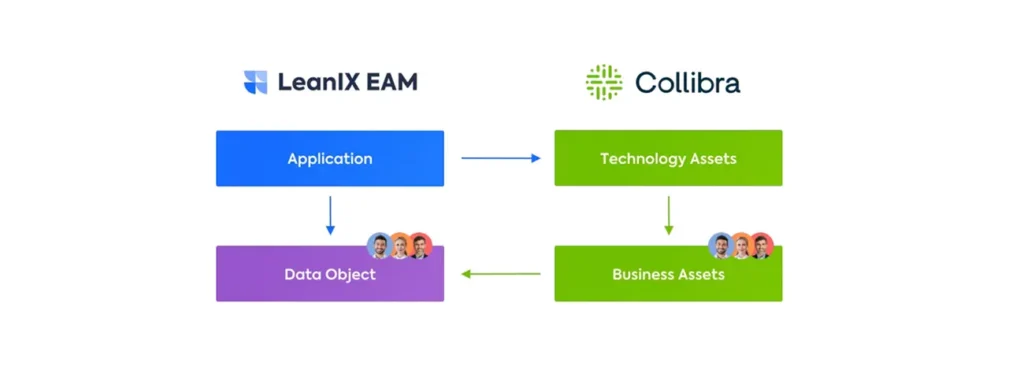
Collibra and LeanIX aren’t native metadata integrations in the same way as Datasphere, but their joint use enhances the governance and architectural ecosystem. The integration helps align data architecture (in Collibra) with enterprise architecture (in LeanIX), so teams can see how data assets relate to technology and business capabilities.
And by linking the technical and architectural context, it improves metadata quality, transparency, and accountability.
How SAP LeanIX and Collibra connect. Source: LeanIX documentation
Comparison: Collibra vs SAP Native Governance Tools (SAP Master Data Governance & SAP Information Steward)
Let’s break it down into several aspects.
Scope and enterprise governance
Collibra is designed as a unified governance platform across SAP and non-SAP systems, providing metadata management, quality, lineage, stewardship workflows, business glossary, policy automation, and AI governance.
SAP’s native tools focus more narrowly within the SAP ecosystem, e.g., MDG handles master data consolidation and rules, and Information Steward focuses on profiling/quality within SAP landscapes.
Metadata and lineage capabilities
Collibra’s strength lies in enterprise metadata management and automated lineage across sources, giving a global view. SAP native tools typically lack comprehensive cross-system lineage for analytics and data governance beyond SAP. Collibra fills that gap for heterogeneous environments, making integration much easier between SAP and non-SAP systems.
Governance workflow and stewardship
Collibra’s governance workflows, role-based dashboards, and stewardship management are robust and built for enterprise-scale governance across teams. SAP’s native tools are powerful for master data and specific profiling tasks, but aren’t designed as a centralized governance hub for hybrid landscapes.
Ease of use and adoption
Collibra’s cloud-centric governance tools tend to be easier for business users and broader governance teams to adopt. Though what’s really important here is to really zero in on adoption right from the start of implementation. Hiring the right Collibra Service Partner is the key here.
SAP Information Steward may be easier to set up initially, but lacks broader governance depth.
Enterprise Data Governance vs. Native SAP Tools
Feature
Collibra unified platform
SAP Native Tools (MDG / Information Steward)
Primary Focus
Centralized, enterprise-wide governance across SAP and non-SAP systems.
Operational master data management and profiling within the SAP ecosystem.
Data Lineage
Automated, cross-system lineage showing data flow from any source to BI/AI.
Narrow lineage, typically focused only on technical flows within SAP landscapes.
Business Context
Robust business glossary and stewardship for non-technical users.
More technical metadata focus, often harder for business teams to adopt.
AI Governance
Dedicated AI governance to manage models, usage, and ethical compliance.
Limited; focused primarily on the data quality feeding into the systems.
Integration
Acts as a “system of engagement” for a heterogeneous (hybrid) data fabric.
Best-in-class for managing data inside SAP, but often siloed from external cloud apps.
How companies like Murdio accelerate your SAP-Collibra strategy
As with any enterprise tools, it’s really not just about the software itself – tool integrations often demand process transformations across the enterprise, and it’s usually much more complex than just a ready-made integration. And that’s what we’re here for at Murdio – to facilitate this and help bring value faster, in the least complicated way.
Like we did for one of our clients – a leading international retail organization – for whom we implemented custom Collibra SAP lineage.
The company faced challenges in tracking and understanding the lineage of critical data attributes such as total shelf life across its complex data ecosystem. And in retail, it’s pretty common to face the challenge of tracing a customer’s journey and accurately attributing sales across a complex landscape of systems, especially with core platforms like SAP.
We developed a transformative solution to address the challenges of tracking and understanding data lineage through a sophisticated technological infrastructure that spanned SAP Master Data Governance (MDG), SAP Business Warehouse (BW), SAP ERP, centralized data lakes, and Collibra business intelligence platforms.
Our work included:
Data source mapping
Automated lineage
Impact analysis
Data quality rules integration
And because we always start with adoption in mind, projects like this are more tailored to your organization’s specific needs and designed to bring results faster, with access to the cross-industry expertise of the entire team of certified Collibra experts at Murdio, even if you’re just working with one.
We’re the only Collibra consulting and implementation company with 14 Collibra Rangers on board. A Collibra Ranger is not just a consultant. They’re technical specialists with over six years of experience in solving the most intractable data governance challenges. And this level of expertise is critical when dealing with SAP’s often poorly documented or customized technical metadata. We combine out-of-the-box solutions (e.g., configuration of specialized integrators such as the ERP/CRM Integrator) with deep technical expertise to build custom integrations where standard tooling is not enough.
Our team includes specialized roles that address every aspect of the implementation:
Collibra Developers: Building custom features, integrations, and BPMN 2.0 workflows to automate governance processes.
Integration Developers: Experts in Java, Python, and REST APIs who write flawless integrations between Collibra and diverse data sources like Snowflake, Databricks, and S/4HANA.
Technical Product Owners (TPOs): Strategic leaders who bridge the gap between business requirements and technical execution. A Murdio TPO embedded in a global energy leader’s team successfully streamlined a backlog of 350+ tasks by standardizing development processes and optimizing data models. (Read the full case study here.)
A business data fabric is more than a nice-sounding phrase. It supports analytics, compliance, operations, migrations, and AI – and you can build it for your enterprise by integrating SAP’s enterprise-grade data platforms with Collibra’s governance and intelligence capabilities.
If your enterprise is modernizing its SAP landscape, scaling analytics, or pursuing data-driven innovation, we can help you turn data governance from a blocker into a competitive advantage and a business enabler. We’ve successfully delivered SAP + Collibra integrations for global organizations.
No. SAP and Collibra are complementary. They solve different problems and are designed to work together.
SAP focuses on:
Running operational business processes
Managing transactional and analytical data platforms
Collibra focuses on:
Data governance, quality, lineage, and stewardship
Business context and policy enforcement across systems
No, even SAP-centric organizations benefit from Collibra. Most SAP enterprises still struggle with:
Business understanding of SAP data
Cross-system lineage
Data quality visibility beyond technical checks
Collibra adds value even in heavily SAP-based landscapes, and becomes critical once non-SAP tools, cloud platforms, or AI use cases are introduced.
No. Collibra does not replace SAP MDG. In mature setups, MDG and Collibra coexist, each serving a distinct role.
SAP MDG governs how master data is created and maintained inside SAP
Collibragoverns how data is understood, trusted, reused, and monitored across the enterprise.
Yes, indirectly, but importantly.
Collibra does not migrate systems, but it helps reduce migration risk and post-migration surprises by:
Cataloging legacy and target data structures
Exposing data quality issues before migration
Providing lineage and impact analysis
Creating a shared data understanding across teams
How does Collibra integrate with SAP Datasphere and SAC?
Collibra ingests metadata from SAP Datasphere and SAP Analytics Cloud, including:
Tables, views, columns, and models
Analytical artifacts and relationships
This metadata is then governed alongside non-SAP assets, giving teams a unified view of enterprise data.
AI scales both value and mistakes.
Without governance:
Poor-quality SAP data feeds AI models
The risk of sensitive data being fed to AI models goes up
Semantic misunderstandings go undetected
Compliance and explainability become impossible
Collibra adds quality checks, lineage, ownership, and usage controls that make SAP data safer for AI.
Primarily, yes, but not exclusively.
The SAP-Collibra alliance delivers the most value where:
Data is reused across many teams
SAP data feeds analytics or AI
Compliance and auditability matter
Multiple SAP and non-SAP systems coexist
That said, mid-size organizations planning growth or cloud migration benefit from putting governance in place early.
About the Author
Karolina Fox
Karolina Fox is the Director of Business Development at Murdio, where she leads marketing and growth initiatives focused on data governance and Collibra implementations. With a background in B2B strategy and hands-on experience working with enterprise clients, she specializes in translating complex data topics into clear, actionable insights. On the Murdio blog, she shares practical perspectives on data governance, implementation challenges, and how to drive real business value from data intelligence platforms.
This Website uses cookies to provide you with an optimised experience. For more information about the cookies we use go to our Privacy Policy (available at https://murdio.com/privacy-policy/ ). Click on the "Details" button to see which cookies you accept. By clicking "Accept" you accept default cookie settings.
Functional
Always active
The technical storage or access is strictly necessary for the legitimate purpose of enabling the use of a specific service explicitly requested by the subscriber or user, or for the sole purpose of carrying out the transmission of a communication over an electronic communications network.
Preferences
The technical storage or access is necessary for the legitimate purpose of storing preferences that are not requested by the subscriber or user.
Statistics
The technical storage or access that is used exclusively for statistical purposes.The technical storage or access that is used exclusively for anonymous statistical purposes. Without a subpoena, voluntary compliance on the part of your Internet Service Provider, or additional records from a third party, information stored or retrieved for this purpose alone cannot usually be used to identify you.
Marketing
The technical storage or access is required to create user profiles to send advertising, or to track the user on a website or across several websites for similar marketing purposes.